Neural fields and population models
How can activity distributed across neural tissue be understood without following every individual neuron? Neural-field and population models provide a mathematical description of collective activity, while retaining enough spatial and temporal structure to explain waves, localised states and brain rhythms.
Waves, bumps and spatial patterns
Neural fields describe the evolution of population activity through nonlocal coupling: the response at one location depends on activity elsewhere, weighted by the strength and spatial range of synaptic interactions. This deceptively simple formulation supports travelling fronts and pulses, stationary bumps, breathing states and spatial pattern-forming instabilities.
Our work develops methods for constructing these solutions and determining their stability. Threshold firing-rate functions can make it possible to reduce some of the analysis to the motion of activity interfaces. Evans-function techniques and spectral methods then help identify the onset of instabilities, including drift, breathing and symmetry-breaking of localised patterns.
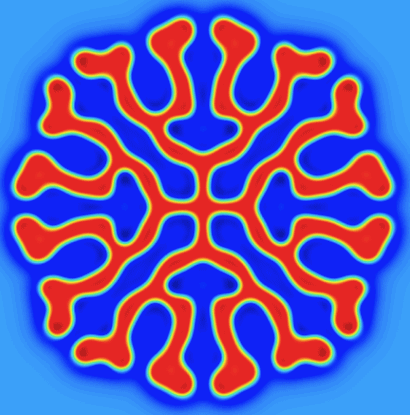
I am also interested in quasiperiodic patterns and quasicrystalline organisation in neural-field models. For a visual exploration of these patterns, see Oliver Smith’s quasicrystal page.
From spiking networks to population dynamics
Classical neural-mass models track coarse-grained quantities such as mean activity and synaptic response. They have proved useful for describing rhythms, but a firing rate alone does not generally encode how tightly neurons are synchronised.
An important development is the construction of next-generation neural masses from populations of spiking neurons. For certain neuron models and distributions of excitability, mean-field reductions yield equations for population activity and synchrony. Extending these descriptions across space gives neural-field models that can address the interplay between coherent oscillations, waves and nonlocal connectivity.
This provides a route between single-neuron dynamics and measurements of collective brain activity, while also making clear what information is lost when a network is replaced by a purely rate-based description.
Brain modes and large-scale dynamics
At the scale of the whole brain, spatial coupling, conduction times and cortical geometry help organise patterns of activity. One aim is to understand the relationship between the modes of a structural network and the spatiotemporal waves supported by a continuum description of neural tissue. This connects neural-field theory with more recent work on large-scale brain modelling and white-matter networks.
Related talk: Large-scale brain modelling: from nodes to white matter networks (video), BrainModes 2025, Fields Institute, Toronto (8 October 2025).
Selected publications
- O. Cattell, A. Mayora-Cebollero, R. D. O’Dea, R. Barrio and S. Coombes (2026), Understanding tonic-clonic seizure transitions as secondary bifurcations in a neural field model, Proceedings of the Royal Society A 482 (2338), 20250452.
- S. Coombes (2023), Next generation neural population models, Frontiers in Applied Mathematics and Statistics 9.
- Á. Byrne, R. O'Dea, M. Forrester, J. Ross and S. Coombes (2020), Next generation neural mass and field modelling, Journal of Neurophysiology 123, 726–742.
- S. Visser, R. Nicks, O. Faugeras and S. Coombes (2017), Standing and travelling waves in a spherical brain model: the Nunez model revisited, Physica D 349, 27–45.
- S. Coombes, H. Schmidt and I. Bojak (2012), Interface dynamics in planar neural field models, Journal of Mathematical Neuroscience 2, 9.
- S. Coombes (2005), Waves, bumps, and patterns in neural field theories, Biological Cybernetics 93, 91–108.
- S. Coombes and M. R. Owen (2004), Evans functions for integral neural field equations with Heaviside firing rate function, SIAM Journal on Applied Dynamical Systems.