QUANTUM ANALYSIS AND OPERATOR CALCULUS
Quantum Operator Calculus (QOC)
goes back to the Feynman's famous rules for calculation of the variation of
the operator exponential function in the form of a perturbation series. Since
then many authors made attempts to clarify these mysterious rules and put them
on a solid mathematical bases, the most notorious among them was Maslov's
Operator Calculus. My own explicit triangular-matrix
formula

is
the simplest algorithmic form of the operator chain rule which gives an
alternative approach to QOC. It was discovered as a particular case of the
quantum functional "Itô formula" [1, 2] which is based on the canonical
triangular-matrix representation for Quantum-Itô variations
 of four basic QS processes of exchange
 ,
creation
,
creation
 ,
annihilations
,
annihilations
 and preservation
 .
As this formula suggests, finding a variation of a function of operator
.
As this formula suggests, finding a variation of a function of operator
 corresponding to its noncommutative variation
 is reduced to the evaluation of the upper right element
 of the block-triangular operator
 ,
the only nonzero element of the difference
,
the only nonzero element of the difference
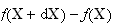 .
Thus the noncommutative chain rule is defined as soon as the function
.
Thus the noncommutative chain rule is defined as soon as the function
 of the block-triangular operator
 ,
where is the
,
where is the
 -ampliation
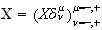 of
of
 ,
and
,
and
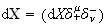 is its
 -nilpotent
variation
-nilpotent
variation
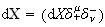 ,
makes sense.
,
makes sense.
Quantum Stochastic Calculus (QSC)
explores the HP (Hudson-Parthasarathy)
"Itô table" which has simple multiplication
structure
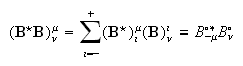
of
the matrix product for the triangular matrices
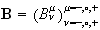 and
and
 having zero elements
 if
if
 or
or
 and indefinite-metric
 -involution
 defined by the reflection
 in the Hermitian conjugate matrix
 .
I discovered this
.
I discovered this
 -algebraic
structure of the Quantum Stochastic Calculus (QSC) in 1987 while developing
nondemolition stochastic calculus for solving quantum time-continuous
measurement problem and filtering [3,4]. Using this underlying 'Heaven
structure' I extended the HP Itô multiplication rule to
quantum functional and nonadapted Itô formula [5]
presented for the adapted QS operator differentials
-algebraic
structure of the Quantum Stochastic Calculus (QSC) in 1987 while developing
nondemolition stochastic calculus for solving quantum time-continuous
measurement problem and filtering [3,4]. Using this underlying 'Heaven
structure' I extended the HP Itô multiplication rule to
quantum functional and nonadapted Itô formula [5]
presented for the adapted QS operator differentials
 in [1,2] as the four differences
sum
in [1,2] as the four differences
sum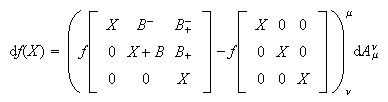
over
 and
and
 .
It was obtained as a down-to-Earth projection of the finite difference chain
rule in a 'Heaven calaculus' underlying the Quantum Stochastic Analysis
developed in [5-8].
.
It was obtained as a down-to-Earth projection of the finite difference chain
rule in a 'Heaven calaculus' underlying the Quantum Stochastic Analysis
developed in [5-8].
Quantum Stochastic Analysis (QSA)
is a development of Quantum Stochastic Calculus (QSC) which started in the
early 80's with the work of Hudson and Parthasarathy (HP) on coherent vectors
in Fock space. My approach, based on Fock scale representation of the basic
processes
 ,
which I defined in [3] as bounded operators on a natural
projective limit domain in this scale, extended the classical
white noise calculus from the generalized functionals
to generalized operators (kernels) on the Fock projective limit. This work
lead to a new 'Heaven calculus' which unifies the HP approach with
Maassen-Meyer kernel calculus and extends the HP QS integrals from the
exponential to the natural kernel domain of the Guichardet Fock and
pseudo-Fock 'Heaven space'. The explicit operator definition of the QS
integrals, introduced in [4], was based on the discovered in [3] canonical
triangular-matrix representation of the QS differentials. This was immediately
generalized to the non-adapted QS processes in my QSA paper [5] by the analogy
with Boson Wick calculus [6]. Thus the quantum analog of Skorohod integral and
Malliavin calculus based on four fundamental QS point derivatives
,
which I defined in [3] as bounded operators on a natural
projective limit domain in this scale, extended the classical
white noise calculus from the generalized functionals
to generalized operators (kernels) on the Fock projective limit. This work
lead to a new 'Heaven calculus' which unifies the HP approach with
Maassen-Meyer kernel calculus and extends the HP QS integrals from the
exponential to the natural kernel domain of the Guichardet Fock and
pseudo-Fock 'Heaven space'. The explicit operator definition of the QS
integrals, introduced in [4], was based on the discovered in [3] canonical
triangular-matrix representation of the QS differentials. This was immediately
generalized to the non-adapted QS processes in my QSA paper [5] by the analogy
with Boson Wick calculus [6]. Thus the quantum analog of Skorohod integral and
Malliavin calculus based on four fundamental QS point derivatives
 instead of a single one as in the classical stochastic calculus was
introduced. The non-adapted quantum Itô formula
instead of a single one as in the classical stochastic calculus was
introduced. The non-adapted quantum Itô formula
derived in [5],
which has the same
form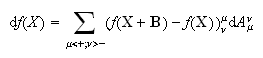
as
in the adapted case but is given by nondiagonal
 -ampliation
 of the operator curve
 with
with
 if
if
 or
or
 and four quantum "Malliavin derivatives"
 , enabled the QS differential formulation of the unitarity and homomorphic
conditions for non-adapted QS differential equations and flows in [5,6]. The
infinite dimensional QSA with respect to the arbitrary quantum white noise was
developed in [7,8], the Quantum Stochastic Calculus (QSC) of for quantum
filtering -- in [9], and the question of finding the QS integrants for Fock
space operators was studied in [10]. Attal and Lindsay recently developed the
adapted version of the QSA on the natural domain of the Guichardet Fock space.
, enabled the QS differential formulation of the unitarity and homomorphic
conditions for non-adapted QS differential equations and flows in [5,6]. The
infinite dimensional QSA with respect to the arbitrary quantum white noise was
developed in [7,8], the Quantum Stochastic Calculus (QSC) of for quantum
filtering -- in [9], and the question of finding the QS integrants for Fock
space operators was studied in [10]. Attal and Lindsay recently developed the
adapted version of the QSA on the natural domain of the Guichardet Fock space.
My 10 Relevant Publications:
- V. P. Belavkin:
The Unified Ito Formula Has Pseudo-Poisson Structure.
Journal of Mathematical Physics 34 (4) 1508--1518 (1993).
- V. P. Belavkin:
Quantum Functional Ito Formula.
In Quantum Probability and Related Topics 8 81--85
World Scientific, Singapore, 1993.
- V. P. Belavkin:
A New Form and *-Algebraic Structure of Quantum Stochastic Integrals in Fock Space.
Rendiconti del Seminario Matematico e Fisico di Milano
LVIII 177--193 (1988).
- V. P. Belavkin:
A Quantum Stochastic Calculus in Fock Space of Input and Output Non-Demolition Processes.
In:
Quantum Probability and Applications LNM 1442 99--125
Springer Verlag, Berlin 1990.
- V. P. Belavkin:
A Quantum Nonadapted Ito Formula and Stochastic Analysis in Fock Scale.
J of Funct Analysis 102 2 414--447 (1991).
math-ph/0512076,
PDF.
- V. P. Belavkin:
A Boson Field Multiple Integrals and Quantum Filtering Equations in Fock Scale.
Centro Matimatico V Volterra, Universita'degli studi di Roma II
80 1--26 (1991).
math.PR/0512362,
PDF.
- V. P. Belavkin:
A Non-Adapted Stochastic Calculus and Non-Stationary Quantum Evolution in Fock Space.
In Quantum Probability and Related Topics 6 137--179
World Scientific, Singapore 1991.
math.PR/0512509,
PDF.
- V. P. Belavkin:
Stochastic Calculus and Filtering in Noncommutative Probability Theory.
DSci Thesis. Steklov Mathematical Institute AN USSR, Moscow 1991.
See also math.PR/0512265,
PDF
of the paper [5] on the QCC page.
- V. P. Belavkin:
Quantum Stochastic Calculus and Quantum Nonlinear Filtering.
Journal of Multivariate Analysis 42 (2) 171--201 (1992).
math.PR/0512362,
PDF.
- V. P. Belavkin and J. M. Lindsay:
The Kernel of a Fock Space Operator.
In Quantum Probability and Related Topics 8 87--94
World Scientific, Singapore 1993.