Brain rhythms and thalamo-cortical dynamics
My interest in thalamo-cortical rhythms began with mathematical models of rebound firing in thalamic neurons. More recently, we have connected these cellular mechanisms to neural population models, with applications to sleep rhythms and responses to sensory stimulation.
Mechanisms of thalamo-cortical rhythms
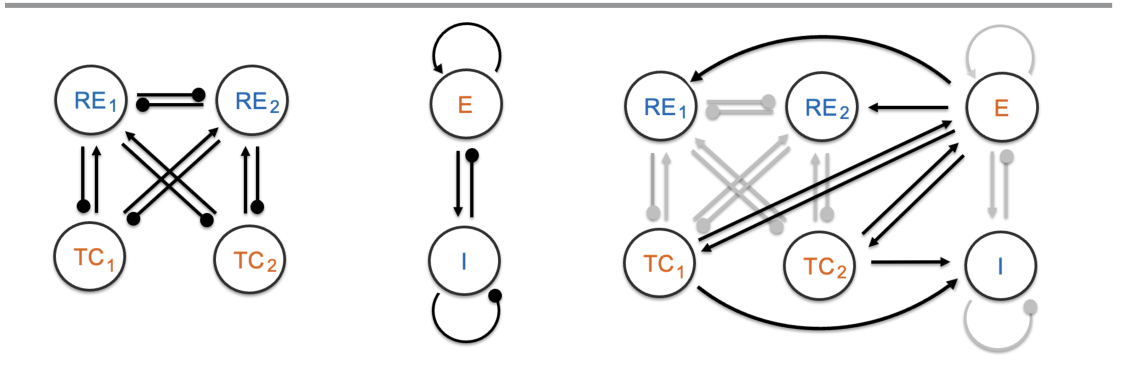
Thalamo-cortical (TC) relay cells and thalamic reticular (RE) cells form an excitatory–inhibitory feedback circuit. Inhibition can deinactivate low-threshold T-type calcium channels in TC cells, permitting rebound activity when inhibition is released. Together with slower ionic currents, these interactions support qualitatively different rhythmic regimes.
My 2003 work on synaptically coupled integrate-and-fire-or-burst neurons examined the dynamics of this TC–RE interaction. A later study with Sunil Modhara, Y.-M. Lai and Rüdiger Thul showed that rebound currents also open up new routes to spatial pattern formation in neural fields. The same mechanisms now underpin work led by Angelica Pozzi, extending the thalamic population description to include the hyperpolarisation-activated current Ih and additional interacting TC–RE populations.
In related work with Mayte Bonilla-Quintana, Kyle Wedgwood and Reuben O’Dea, we studied two-dimensional travelling-wave dynamics in a model of the medial entorhinal cortex involving the hyperpolarisation-activated current Ih. This is a distinct application of rebound-current modelling, rather than a simulation of thalamo-cortical circuitry.
From neural populations to oscillatory states
In collaboration with Angelica Pozzi, Mairi Houlgreave, Stephen Jackson and Reuben O’Dea, we couple this thalamic firing-rate formulation to a next-generation cortical neural mass model. The cortical component represents interacting excitatory and inhibitory populations, including electrical coupling within the inhibitory population, while chemical synapses connect cortical and thalamic populations.
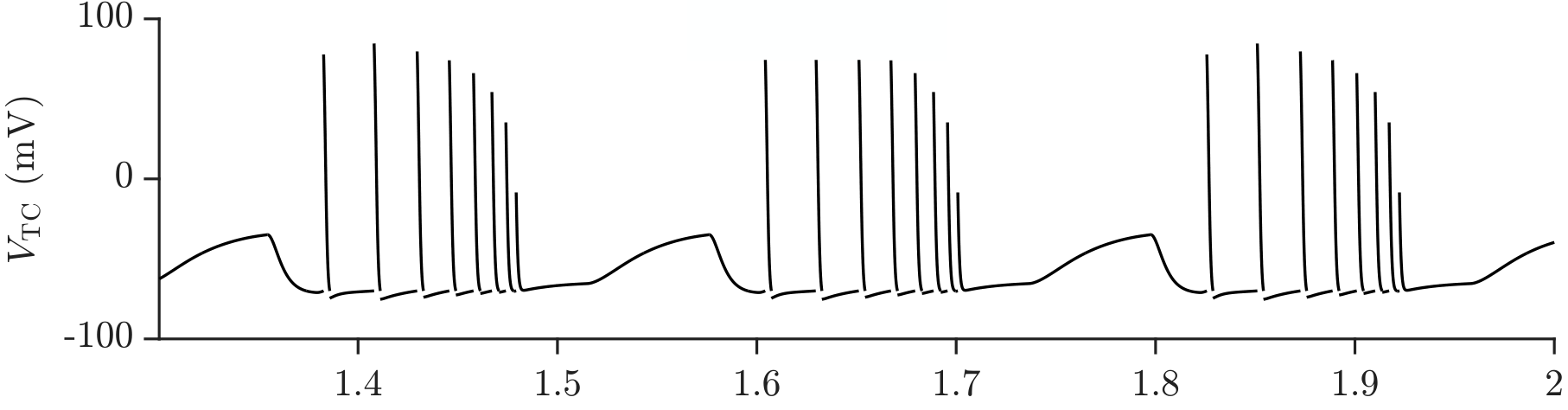
This combined framework reproduces slow-wave oscillations and spindle-like waxing-and-waning activity, including subharmonic TC responses. By changing conductances and coupling strengths we can examine transitions between rhythmic regimes and regions of near-stationary activity.
The useful question is not simply whether the model oscillates, but which conductances and feedback connections distinguish slow waves, spindles and quiescence. This continues the dynamical-systems approach of the earlier IFB work, now at population level.
Sleep also has a slower timescale. In separate work with Mustafa Sayli, Andrew Skeldon, Rüdiger Thul and Rachel Nicks, we analysed the two-process model of sleep–wake regulation using nonsmooth dynamical systems. It provides a complementary description of sleep timing, distinct from the cellular and circuit mechanisms responsible for thalamo-cortical rhythms.
Rhythmic stimulation and Tourette syndrome
An important application is to the effects of rhythmic median nerve stimulation (MNS) on brain activity in Tourette syndrome. This work connects our modelling with research by Stephen Jackson and colleagues at Nottingham, including work associated with the N³ neurotechnology initiative. A sham-controlled clinical study investigated home-administered 10 Hz stimulation for tic reduction.
In Angelica's ongoing work, an imposed rhythmic drive is applied to thalamic populations. The simulated cortical response displays features seen in MEG studies of stimulation, including mu-band entrainment and a post-stimulation beta rebound.
Angelica is also investigating simulation-based parameter inference, starting with tests of parameter recovery and identifiability on synthetic data. The longer-term question is whether a model constrained by recordings can help distinguish changes in thalamic rebound, cortical feedback and population synchronisation. This remains an open modelling problem, not an established explanation of tic suppression.
Selected publications
- M. Sayli, A. C. Skeldon, R. Thul, R. Nicks and S. Coombes (2023), The two process model for sleep-wake regulation: A nonsmooth dynamics perspective, Physica D 444, 133595.
- S. Modhara, Y.-M. Lai, R. Thul and S. Coombes (2021), Neural fields with rebound currents: Novel routes to patterning, SIAM Journal on Applied Dynamical Systems 20, 1596–1620.
- Á. Byrne, R. D. O'Dea, M. Forrester, J. Ross and S. Coombes (2020), Next-generation neural mass and field modeling, Journal of Neurophysiology 123, 726–742.
- M. Bonilla-Quintana, K. C. A. Wedgwood, R. D. O’Dea and S. Coombes (2017), An analysis of waves underlying grid cell firing in the medial entorhinal cortex, The Journal of Mathematical Neuroscience 7, 9.
- S. Coombes (2003), Dynamics of synaptically coupled integrate-and-fire-or-burst neurons, Physical Review E 67, 041910.
Ongoing work: A. Pozzi, M. S. Houlgreave, S. R. Jackson, R. O'Dea and S. Coombes, Thalamo-cortical modelling and parameter estimation in the context of Tourette syndrome (manuscript in preparation).