Coupled oscillators and phase–amplitude reduction
Networks of coupled oscillators provide a framework for understanding synchronisation, phase locking and collective rhythms. Our research develops reductions that preserve important features of the full dynamics, especially when weak-coupling and rapid-amplitude-relaxation assumptions are inadequate.
Beyond phase reduction
Classical phase reduction represents each oscillator by its position on a stable limit cycle. It is especially effective when coupling is weak and disturbances transverse to the cycle decay rapidly. In biological networks, however, slow amplitude relaxation can affect the existence and stability of collective states.
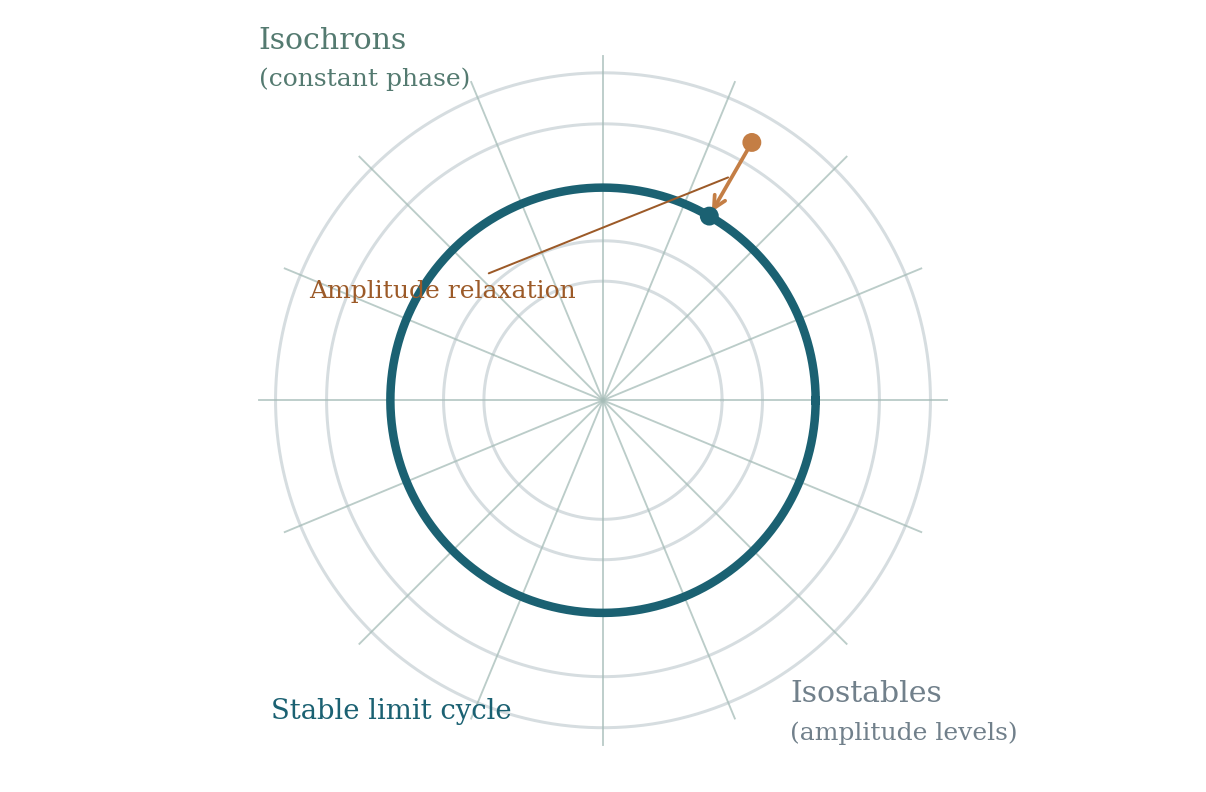
In work with Rachel Nicks, we investigate phase–isostable reduction: each oscillator is described by a phase and an additional coordinate representing its slowest-decaying transverse mode. This supplies information about departures from the limit cycle that phase-only models discard.
The resulting reduced systems can be used to study phase-locked states, synchrony and their stability, including bifurcations that cannot be explained by standard first-order phase reduction.
Here θi is phase, ψi is the leading isostable coordinate, and κi is its (negative) decay exponent; the coupling terms Fi and Gi depend on the chosen model and reduction.
Oscillators with delays
Delay-differential equations can support stable oscillations, but their infinite-dimensional phase space complicates the construction of reduced models. We have developed a harmonic-balance approach for computing phase and amplitude response functions for delay-induced limit cycles, bringing Floquet theory and oscillator reduction together.
This creates a starting point for studying forced and interacting delayed oscillators. In networks, propagation delays can change the frequencies, stability and coexistence of phase-locked solutions, connecting this theme to our work on adaptive conduction delays.
Analytical approaches to oscillator networks
Piecewise-linear and nonsmooth oscillator models offer a complementary route to analytical understanding. Their structure can make periodic solutions, coupling responses and stability calculations accessible while retaining nonlinear network phenomena. At switching boundaries, perturbations must be propagated using appropriate jump conditions, including saltation matrices. This connects oscillator reduction with wider questions in the theory of nonsmooth dynamical systems.
Selected publications
- R. Nicks, R. Allen and S. Coombes (2024), Insights into oscillator network dynamics using a phase-isostable framework, Chaos 34, 013141.
- R. Nicks, R. Allen and S. Coombes (2024), Phase and amplitude responses for delay equations using harmonic balance, Physical Review E 110, L012202.
- S. Coombes et al. (2024), Oscillatory networks: Insights from piecewise-linear modeling, SIAM Review 66, 619–679.
- R. Nicks, P. Chambon and S. Coombes (2018), Clusters in nonsmooth oscillator networks, Physical Review E 97, 032213.
- P. Ashwin, S. Coombes and R. Nicks (2016), Mathematical frameworks for oscillatory network dynamics in neuroscience, Journal of Mathematical Neuroscience 6, article 2.
Work in progress: Phase-isostable reduction of neural oscillator networks with delays (2026, manuscript in preparation).