White-matter computation and adaptive delays
Neural networks communicate through signals that take time to travel. These delays depend on axonal conduction speeds, which can change with myelination. Our research asks how activity-dependent changes in conduction time might reorganise synchrony, phase locking and collective network dynamics.
The timing of communication
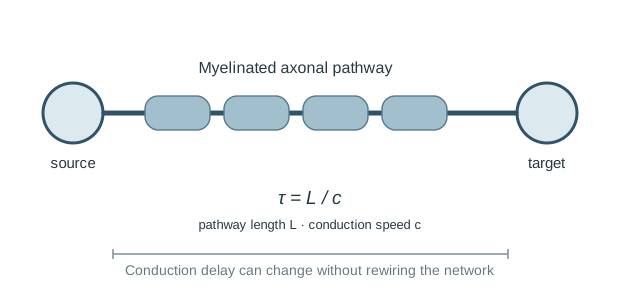
Communication between distant neurons is not instantaneous. For an axonal pathway of length L and conduction speed c, a simple estimate of transmission delay is τ = L/c. Changes in myelin and axonal properties can therefore change when a signal reaches its target, even if the underlying connectivity is unchanged.
This introduces a form of plasticity distinct from changing synaptic weights: the timing of an interaction becomes an adaptive network parameter. The consequences depend on the dynamics of the neurons and on the phase at which delayed inputs arrive.
A related mathematical viewpoint appears in my earlier work with Paul Bressloff on active dendrites. In spike-diffuse-spike models, excitable dendritic spines are coupled through passive cable dynamics, with propagation described through discrete firing events. Fire-diffuse-fire models of myelinated axons use a corresponding construction, with nodes of Ranvier taking the place of active spines. See Coombes and Bressloff (2003).
From fixed delays to adaptive networks
Even fixed transmission delays can produce multiple phase-locked states, with different relative phases and collective frequencies. We analyse these states using models of coupled oscillators and event-based spiking networks, combining self-consistency equations with stability and bifurcation analysis.
When conduction times evolve in response to network activity, the problem becomes one of interacting timescales: fast neural dynamics and slower delay adaptation. A useful viewpoint is to first understand the states supported by fixed delays, then investigate how plasticity moves the network among them.
Can delays shape network computation?
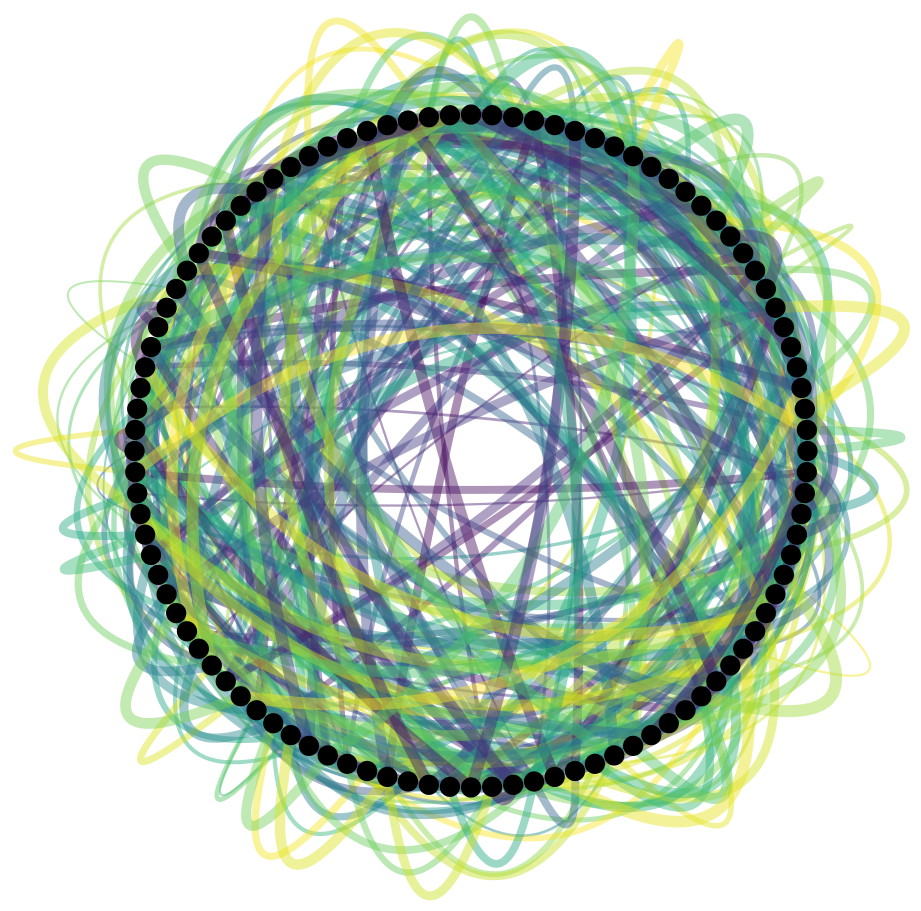
In the Haken–Lighthouse framework, our work with Rüdiger Thul, Stefan Ruschel and Rachel Nicks develops a spike-time stability theory for networks with transmission delays. We then introduce a phenomenological white-matter plasticity rule that adapts conduction speeds. In the model, adaptation can promote phase locking, select timing relationships and cause slow switching between collective spiking states.
Related work on delayed phase-oscillator networks, with Grace Jolly and collaborators, retains the delays explicitly rather than replacing every delay by a fixed phase shift. This makes it possible to examine competing phase-locked solutions and the changes produced by state-dependent delays. A further study investigates frequency selection and network attractors generated by adaptive axonal delays.
In collaboration with Jérémie Lefebvre, we are also exploring the link between biophysical models of myelinated axons and adaptive conduction delays.
These results suggest a mathematical route by which the temporal structure of connectivity could help organise network activity. They are mechanisms explored in idealised models, not evidence that a particular physiological myelination rule has been established.
Selected publications and preprints
- S. Coombes, R. Thul, S. Ruschel and R. Nicks (2026), Adaptive conduction delays and phase locking in spiking Haken Lighthouse networks, Biological Cybernetics, 120, article 37.
- G. Jolly, R. Nicks, S. Ruschel, G. Iskenderoglu and S. Coombes (2026), Phase oscillator networks with multiple and state-dependent delays: A framework for exploring white matter plasticity in neurodynamics, preprint.
- S. Ruschel, E. Hristov, H. G. E. Meijer, S. Coombes and R. Nicks (2026), Network Attractors driven by Time-Delay Plasticity, preprint.
- M. Şaylı and S. Coombes (2024), Understanding the effect of white matter delays on large scale brain synchrony, Communications in Nonlinear Science and Numerical Simulation 131, 107803.