Spiking networks and the Haken–Lighthouse model
The Haken–Lighthouse model describes networks that communicate through discrete spike events, yet retain a mathematical structure that makes collective dynamics unusually tractable. Our work exploits this to analyse phase locking, stability and spatial pattern formation directly in terms of spike timing.
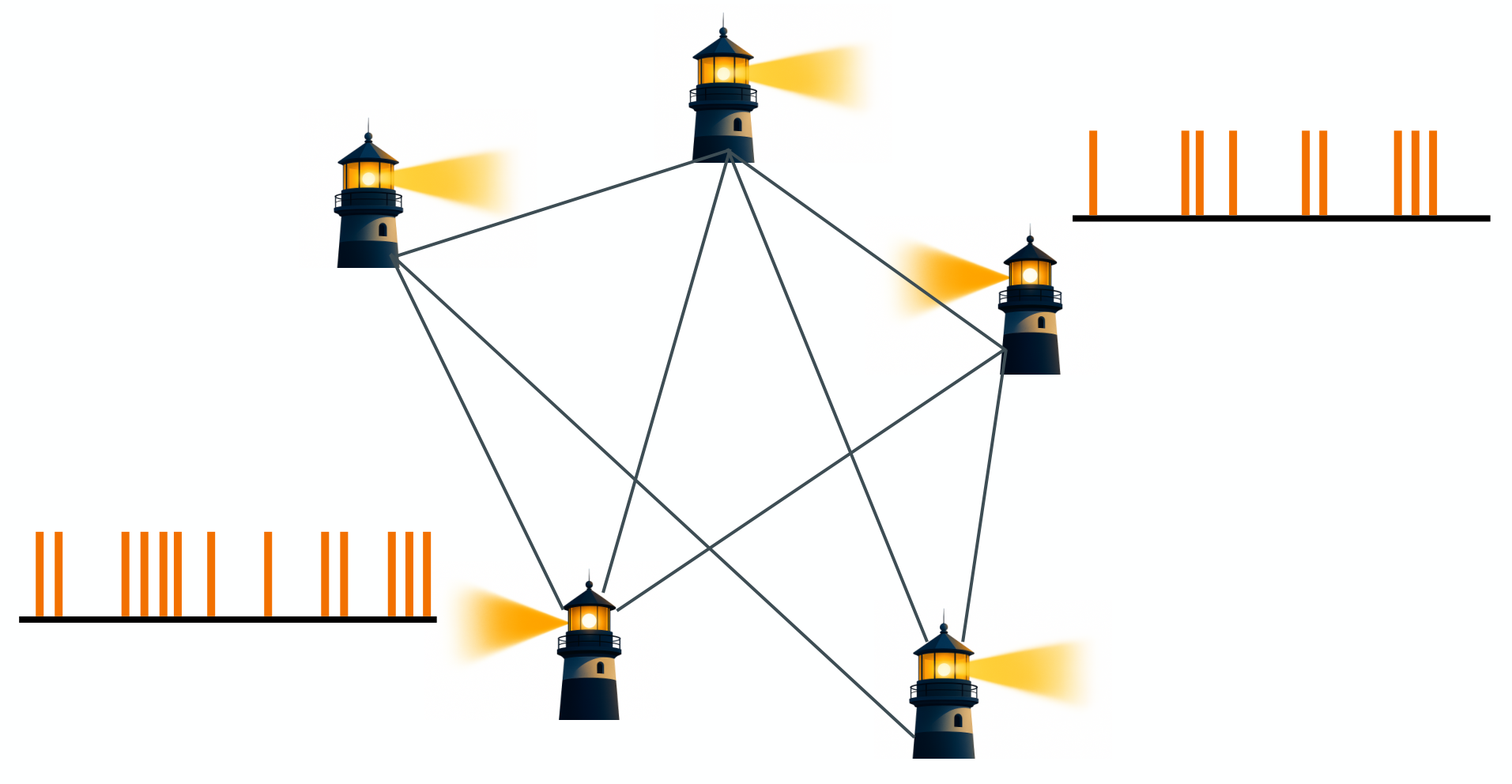
The Lighthouse model
Hermann Haken introduced a model of pulse-coupled neural networks in which spikes trigger signals that are filtered and transmitted between units. The event-based formulation makes it possible to study collective behaviour directly through the timing and interaction of spikes.
This leads to a mathematical description based on self-consistent spike trains. Periodic firing patterns can be constructed from their event times, and their stability analysed by perturbing those times rather than approximating the network by firing rates.
H. Haken, Brain Dynamics: Synchronization and Activity Patterns in Pulse-Coupled Neural Nets with Delays and Noise (Springer, 2002).
From spike times to collective dynamics
The event-based structure provides a route to the existence and stability of synchronised states, phase-locked solutions, travelling waves and spatially structured patterns. In spatially extended networks, it is possible to study pattern-forming instabilities in the spike times themselves, including spatially periodic activity and localised states.
Conduction delays add a further dynamical variable: not just which units communicate, but when their spikes reach their targets. These results connect the original Haken–Lighthouse construction to our ongoing work on adaptive delays and white-matter computation.
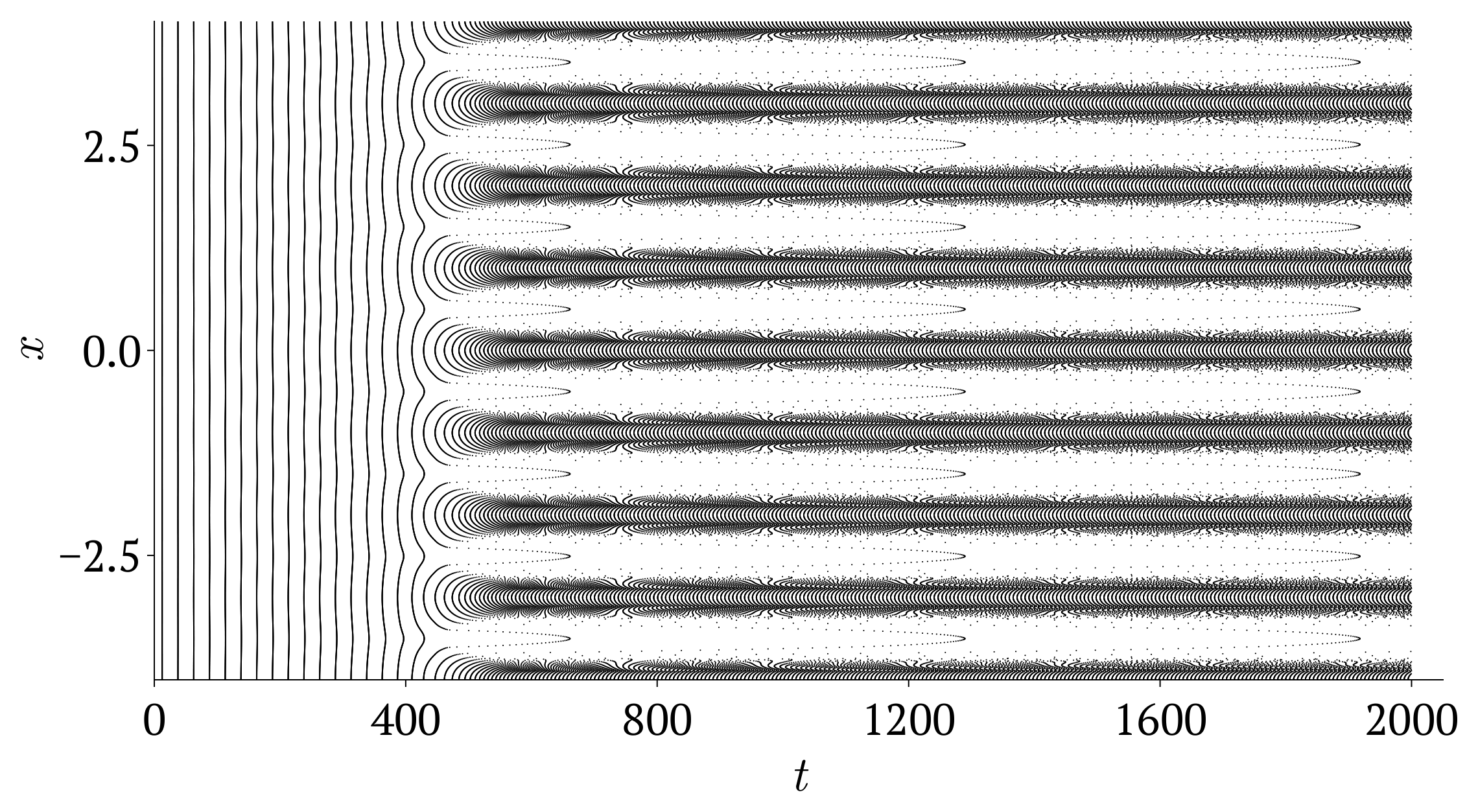
This research featured in my plenary lecture, Revisiting the Haken Lighthouse Model: Bridging Spiking and Non-Spiking Neural Networks, at ICMNS 2026, Montréal.
Alongside the spike-time analysis, we are developing a rate–timing reduction for networks with slow synapses. This couples a population activity variable to a timing variable inherited from the underlying spikes, allowing us to investigate oscillatory instabilities and spatial patterns in a non-spiking description while retaining information about event timing.
Haken–Lighthouse publications
- S. Coombes, R. Thul, S. Ruschel and R. Nicks (2026), Adaptive conduction delays and phase locking in spiking Haken Lighthouse networks, Biological Cybernetics, 120:37.
- S. Coombes, R. Thul, S. Ruschel and R. Nicks (2026), A rate–timing reduction for event-based spiking neural networks (manuscript in preparation).
- S. Coombes (2025), Revisiting the Haken Lighthouse Model, European Physical Journal Special Topics.